
About Pugmill CMS
A lightweight, open-source CMS built on Next.js for developers who want modern flexibility without the bloat.
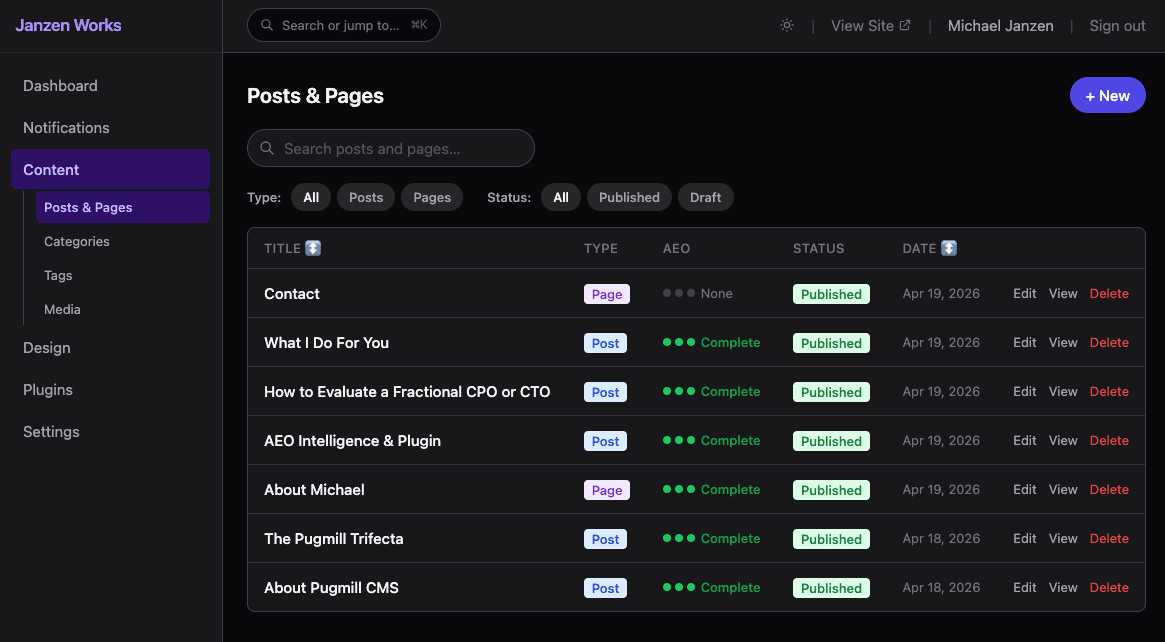
Pugmill CMS is an open-source content management system built on Next.js, PostgreSQL, and Drizzle ORM. The system targets developers and small teams requiring a modern stack without the overhead of a traditional CMS. Answer engine optimization ships as a native feature. Plugins add functionality, including a built-in MCP server, outbound webhooks, and AI provider-powered content generation and editing.
What Pugmill Is
Pugmill is a headless-ready CMS shipping with a native front-end theme system. The admin interface covers posts, pages, media, and users. A plugin architecture allows extending functionality without modifying the core codebase. The system stores content as Markdown and utilizes a hierarchical structure for nesting pages.
Who It's For
Pugmill targets developers setting up content sites. Operating the system assumes comfort with a terminal and environment variables. Users manage content, design, and plugins through the admin interface. Built for workflows pairing one human with one AI agent, the platform assumes the human sets the direction while the AI agent contributes context and execution. Testing covers Claude Code and similar AI-native environments.
Philosophy
Core functionality includes operations running continuously, requiring deep integration, or establishing trust boundaries. Tasks an AI agent can execute as a one-off action remain outside the core product. All features function without an AI provider configured. Connecting a provider adds generation, suggestion, and automation to those existing capabilities.
Core Capabilities
Integrating an AI agent involves community recipes following the agent skills open standard. Compatible agents read a recipe markdown file directly from a repository URL for installation. A built-in skill assists agents in packaging and publishing new extensions.
Pugmill implements the llms.txt specification. It serves per-post metadata including summaries, question-and-answer pairs, and entities. Bot analytics track AI crawler and search spider visits to these endpoints.
The presentation layer uses React and Next.js, featuring swappable themes, server components, and a design token system. A public REST API provides cross-origin resource sharing, pagination, and data envelopes for external frontends.
Content creation relies on a Markdown-first editor. Editors toggle between visual and raw Markdown views. Each post save generates a revision snapshot, allowing users to restore previous versions.
Storage and Security
Storage abstractions support local filesystems and S3-compatible providers. Pre-commit hooks scan staged files for hardcoded secrets and connection strings. Admin routes require an authenticated session with specific role permissions. HTML rendering relies on sanitization to process raw inputs before display.
Technology Stack
The project uses Next.js 15 for the framework and TypeScript 5 for the language. Data management relies on PostgreSQL 16 and Drizzle ORM. Authentication uses NextAuth v5, supporting credentials and OAuth providers. Tailwind CSS 3 handles styling, and Tiptap 3 provides the editor interface.