
AEO Pugmill: A 3-Prong Startup
A three part startup that provides advanced AI-native publishing features, answer engine optimization, and builds a unique dataset.
The Problem
Individually, on our own sites, we track the content and endpoints bots are seeking. We refine our SEO and content strategies, but we lack a view of the big picture. Occasionally, a trusted source publishes its findings, and while that is helpful, it still isn't a holistic view of the shifting SEO/AEO/GEO landscape.
We also can't see which new endpoint types are more effective, such as JSON-LD, Q&A pairs, named entities, and LLMS.txt. This is mainly because most sites don't inject this sort of content.
The Solution
A central place for collecting data on what bots consume across thousands of sites fills that gap. To address this, I built two collection methods and one analytics aggregator, an AI-native AEO trifecta.
Prong 1 - WordPress Plugin
The Pugmill AEO Plugin for WordPress injects these new content endpoints and tracks which bot visits each endpoint. Data is sent daily to the Pugmill Intelligence Network (post opt-in).
It's designed to work alongside SEO plugins, augmenting them. Also included are AI-native content refinement tools powered by a BYOK (bring your own key) AI API key.
A "pro" version of the plugin is available for a small subscription fee, unlocking convenience and automation. Revenue from pro plugin subscriptions will cover the operational costs for the intelligence network. This is the only direct revenue-generating piece of the three-part Pugmill family.
Prong 2 - AI-Native CMS
Vibe-coding adoption is growing, and developers are pushing back on vendor lock-in. To meet that demand, I created Pugmill CMS, a rebuildable, AI-native CMS (content management system) for developers who want to fork and modify their own app.
It's a headless-ready CMS with a built-in React head. It will remind you of the early versions of WordPress, but it's a modern web application and loaded with AI-powered features (MCP server, webhooks, key management, content editing, and generation).
After the AI features, answer engine optimization is the main value proposition, and just like the WordPress Plugin, it connects to the Pugmill Intelligence Network (post opt-in).
The tech stack is Next.js, Typescript, PostgreSQL, Drizzle ORM, and NextAuth. I'm releasing the code as an open-source project under the MIT License to lower adoption friction.
Prong 3 - AEO Data Aggregator
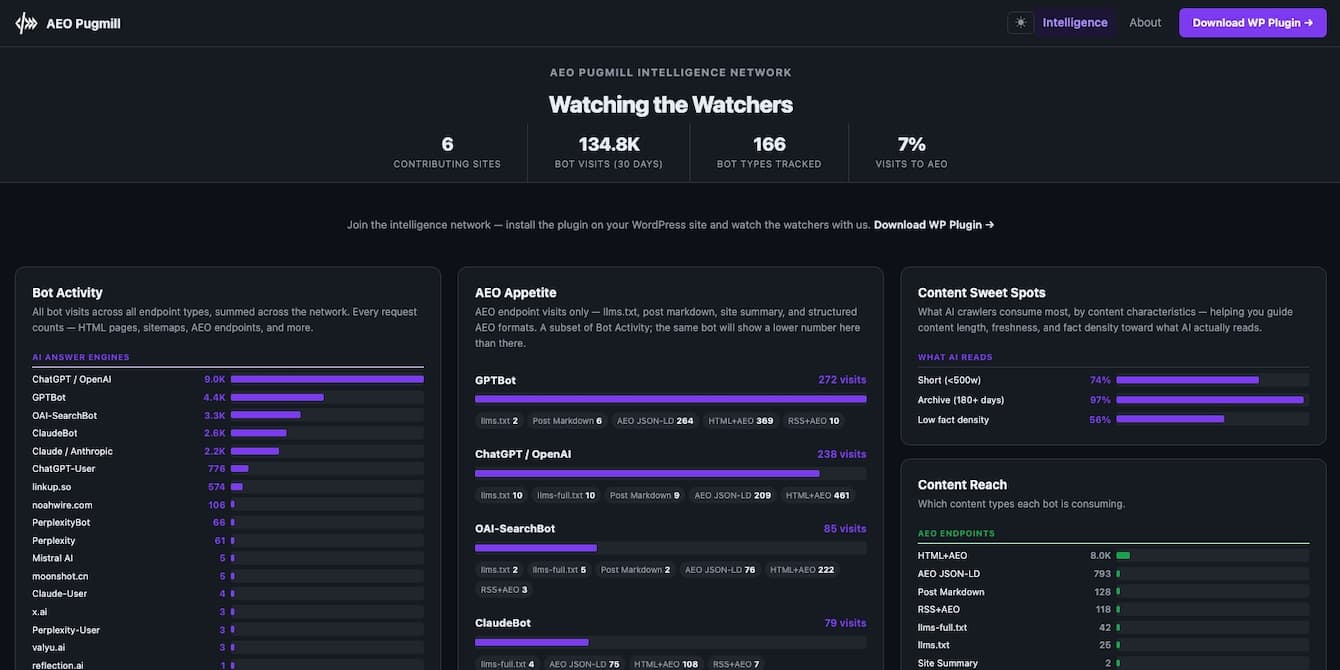
The AEO Intelligence Network aggregates data from the plugin and the CMS. All participating sites send anonymous data every 24 hours; the aggregator ingests the raw data and presents the results to the public for free. While not directly revenue-generating, this is where the dataset accumulates through bot activity and shows us which endpoints perform best.
Why Pugmill?
Like a pugmill in a ceramics studio that takes scraps, slop, and trimmings and converts them back into usable clay, AEO Pugmill takes content and transforms it into a form ready for consumption by answer engines and search spiders.
The two input sources are the funnel for bot activity, and the intelligence network is where the data accumulates. The input sources enable easy user adoption, provide value to content publishers, and help refine SEO strategy. One input source funds the project and MMR. The data repository is where the business's long-term assets accumulate. Together, the three components track shifts in SEO, AEO, and GEO.
Taking It from Zero to One
My first exploration of AEO involved manually injecting these emerging endpoints into a static website for one of the books I wrote in 2025. Within days of adding these content endpoints, my website dominated Google's SERP for the book title's keywords after adding JSON-LD, Q&A pairs, named entities, and an LLMS.txt file.
From there, I formed a plan to build this combination funnel and a data repository. Then, working with Claude Code as my lead developer, I built and launched all three apps in about five weeks.
The go-to-market plan rests on the plugin's utility to publishers and the CMS's appeal to developers. In other words, organic growth depends on product quality, low adoption friction, and the dataset's utility to publishers.
The Long View
As the product set gains adoption, subscription revenue should cover operational costs while the dataset accumulates. In other words, the value of this business grows as the dataset of answer-engine behavior grows. The plugin MRR and CMS adoption growth drive growth.