
The Value of Code is Going to Zero
As AI drives the marginal cost of code toward zero, software stops being the asset. Value shifts to data, distribution, compliance, and the seven moats AI cannot replicate.
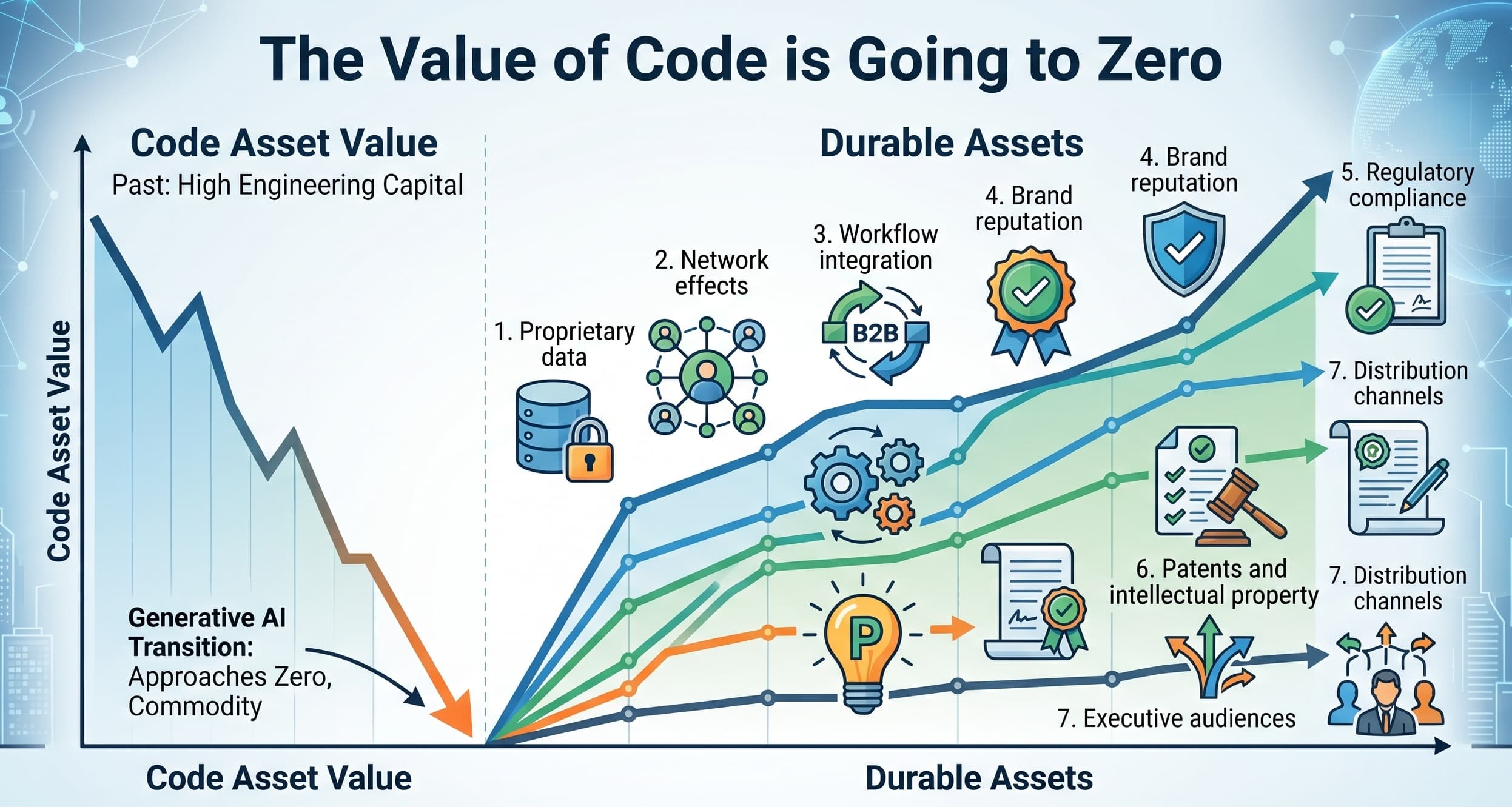
For two decades, the software-as-a-service industry operated on the premise that writing code required significant capital and engineering hours. Software served as a primary asset. Investors valued companies based on engineering complexity and shipped features, anticipating that competitors would need comparable capital to replicate the product.
Generative AI changes this significantly.
AI coding assistants and autonomous agents generate, debug, and deploy applications at a lower cost. The marginal cost of creating software approaches zero. Code transitions from a proprietary asset to a commodity.
Competitors cloning a feature set via AI means the codebase ceases to function as the valuation anchor. Valuations shift toward the ecosystem surrounding the software. Durable assets resist AI replication.
1. Proprietary data
AI models require context to be most useful. Sometimes this is training data, but the most valuable context is your data. Access to baseline LLMs shifts the advantage to organizations with private data. A company with years of customer behavior records, transaction histories, or specialized industry data holds an asset that an AI cannot hallucinate. Replicating an algorithm is technically feasible; legally replicating a private database presents a barrier. Data is a durable asset.
2. Network effects
A product gains utility as the number of users increases. Platforms like GitHub or Figma benefit from user density. Cloning a social network's codebase yields a product without a user base. AI simulates user personas but cannot synthesize human networks, peer-to-peer trust, or established marketplaces. Your customer base and community are durable assets.
3. Workflow integration
SaaS products integrated into daily operations (billing, HR systems, physical supply chains) require effort to replace. Substituting a core system with an AI-generated alternative introduces friction, retraining requirements, and operational risk. Entrenchment relies on time and change management. Integrations establish B2B relationships and a form of lock-in, durable assets.
4. Brand reputation
Decreased software creation costs increase the volume of available tools. Brand reputation functions as a filter for buyers. Enterprise buyers purchase from companies demonstrating security, human support, and financial stability. Trust develops over years of consistent delivery. AI cannot generate a track record of past performance. Build and protect your brand, a durable asset.
5. Regulatory compliance
Navigating compliance requires manual processes. Achieving SOC 2 Type II, HIPAA compliance, FedRAMP authorization, or specific European data privacy standards involves audits, legal frameworks, and physical security measures. Prompting an AI does not grant government security clearances or pass third-party legal audits. Robust regulatory compliance is a trust layer AI can help achieve, but since AI cannot replace human judgment and accountability, making the system hardened for regulatory compliance a durable asset.
6. Patents and intellectual property
Protecting standard code is difficult. Novel methodologies, hardware-software integrations, or applied algorithms qualify for patent protection. Legal intellectual property creates a government-enforced barrier independent of a competitor's coding capabilities. The legal system defends the asset, and upholds its value as a durable asset.
7. Distribution channels
Reaching customers determines product viability. Companies owning distribution mechanisms (email lists, established sales forces, exclusive partnerships) possess a structural advantage. Attention is finite. AI generates marketing copy but does not provide an engaged audience of industry executives. Holding established relationships with an existing audience makes distribution channels a durable asset.
Conclusion
Code represents a primary initial expense for SaaS startups. The transition of code away from being a durable asset presents a manageable structural shift. Executing a go-to-market strategy, establishing vendor relationships, and forming partnerships build the underlying business value. Software functions as the utility enabling this asset generation. Competitors rewriting an application duplicate the code. Duplicating the established business infrastructure, compliance records, and client relationships requires historical operational time.